
International Megan's Law
What is International Megan's Law (IML)?
In 2016, Congress enacted International Megan’s Law to Prevent Child Exploitation and Other Sexual Crimes Through Advanced Notification of Traveling Sex Offenders.
More commonly referred to as International Megan’s Law (IML), it contains a number of notable provisions.
A brief summary of the most important sections of International Megan’s Law is below.
#1 — Angel Watch Center
The Angel Watch Center (AWC) operates under the Immigration and Customs Enforcement’s (ICE) Child Exploitation Investigations Unit (CEIU) and is empowered by the International Megan’s Law (IML) to carry out specific activities.
AWC primarily receives information about an individual’s intended international travel from Customs and Border Protection’s National Targeting Center, rather than from individual offenders or local registration officials.
For example, if you are a registered citizen and you inform your local registry office of your intent to travel — this information about your travel plans will go through their internal channels, ultimately getting to the AWC.
IML grants AWC the authority to identify registered sex offenders planning to travel internationally, specifically those convicted of sex offenses against minors. If AWC identifies such individuals, it can then share relevant information with the destination country.
Additionally, AWC must consult with the National Sex Offender Targeting Center to ensure the individual is complying with sex offender registration requirements.
#2 — National Sex Offender Targeting Center
In 2011, the SORNA Supplemental Guidelines introduced a mandate requiring jurisdictions to have sex offenders report any intended international travel at least 21 (twenty-one) days in advance.
Offenders must provide details about their travel plans and intended destinations, and this information must be communicated to the National Sex Offender Targeting Center (NSOTC) within the U.S. Marshals Service.
The IML reinforces these requirements, specifically authorizing NSOTC to: (1) notify destination countries about sex offenders who have provided advance notice of their travel plans or whose travel has come to NSOTC’s attention through AWC, and (2) share information about these offenders with appropriate federal, state, and local authorities as needed.
#3 — Sex Offender Notification of International Travel
The IML amends the Sex Offender Registration and Notification Act (SORNA) (34 U.S.C. § 20914(a)) to require sex offenders to report specific information about their intended international travel.
This amendment builds on existing SORNA requirements outlined in the Supplemental Guidelines.
#4 — Amendment to 18 U.S.C. § 2250
The IML also modifies the federal failure to register statute (18 U.S.C. § 2250) to make it a criminal offense for individuals to neglect the advance notice of their international travel as mandated by the SORNA amendments.
#5 — Passport Identifiers for Sex Offenders
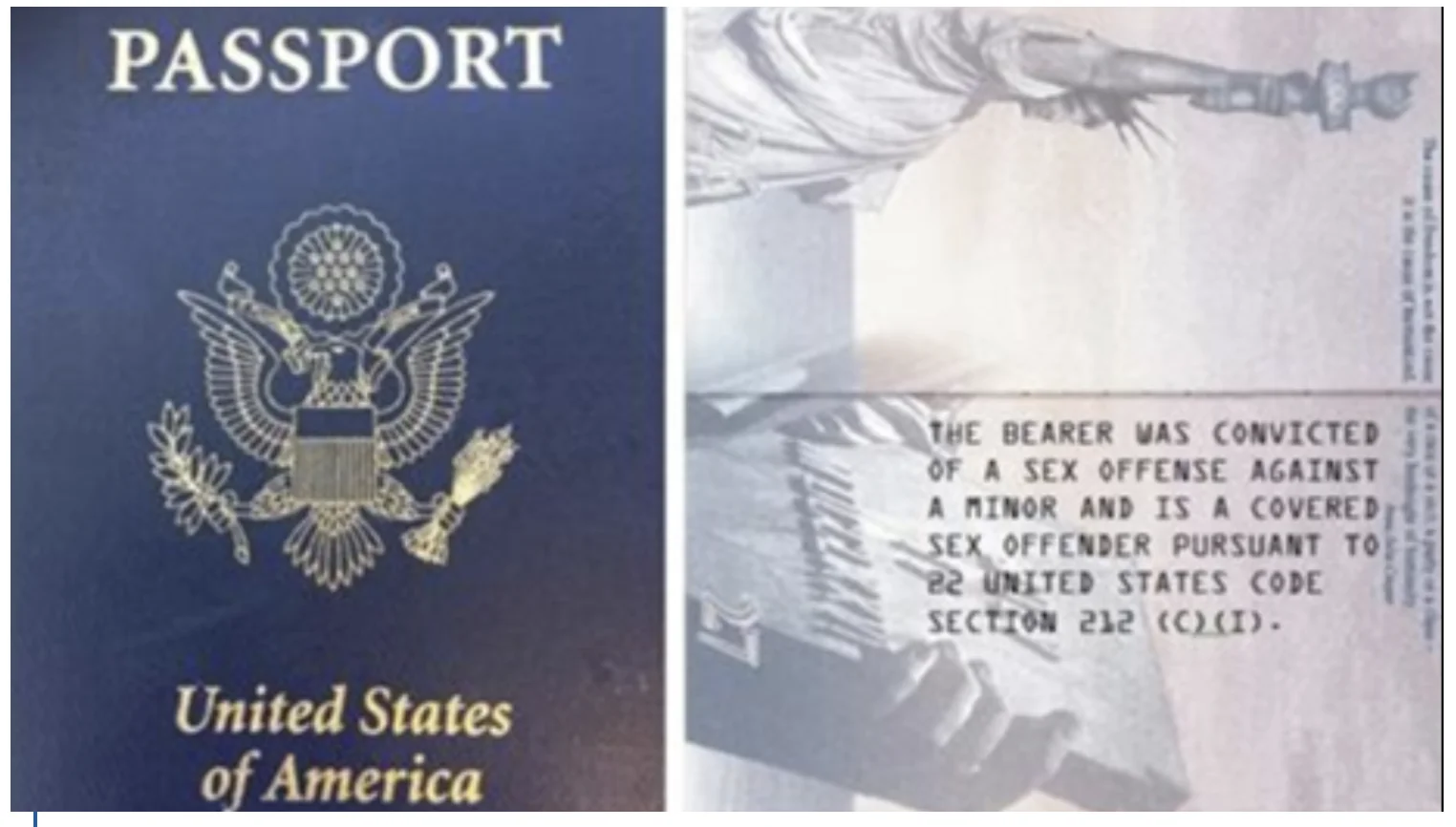
Under the IML, the Department of State is prohibited from issuing passports to “covered sex offenders” unless these passports include a “unique identifier.”
This applies to anyone currently required to register as a sex offender due to a conviction for a sex offense against a minor.
The unique identifier consists of a passport endorsement stating: “The bearer was convicted of a sex offense against a minor and is a covered sex offender pursuant to 22 United States Code Section 212b(c)(1).”
Conclusion
If you or someone you know is either on the Sex Offender Registry or is facing charges that could place them on the registry, contact us — we are here to help.
Our experts work with clients and their families to understand what the Registry is like, the challenges that exist throughout the states, how to navigate SORNA, how to successfully travel within the U.S. and internationally, and more.